For most of history, new work was rare.
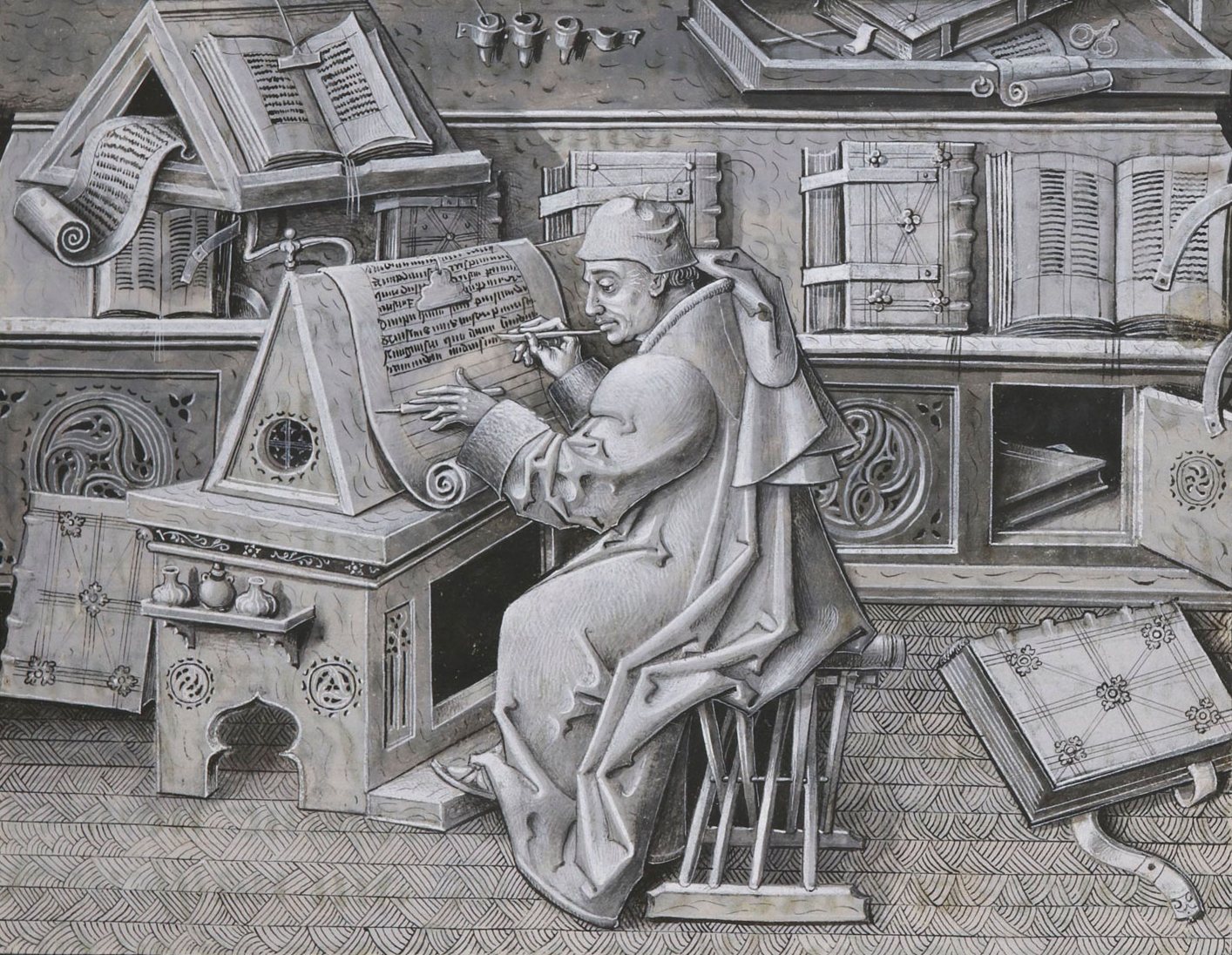
In 1025 the whole world wrote perhaps 400 new books, each one copied by hand. A song lived only as long as someone remembered it. Nobody had ever taken a photograph.
Then, one invention at a time, over the course of history, the cost of making things and of sharing them began to fall steadily toward zero.
Here is what that looks like, one tile per work.
Endless play
Another way to feel the size of one year: line it all up and play it back to back, never stopping to sleep. When would you have needed to start, to finish today?
How long to view last year’s content?
How many lifetimes?
Put one year of new work on one side of a scale. On the other, pile up human lives, each spent reading, listening or watching at a typical pace. How many does it take to balance?
How it exploded
Each medium had its own trigger, but the recipe was always the same.
- 1Making got cheap. A press, a studio, a darkroom, a film crew: they now fit in a pocket.
- 2Sharing got free. No printer, label, broadcaster or gallery has to say yes.
- 3Everyone joined in. 342 million people were alive in 1025. Today there are 8.2 billion, and 6 billion of them are online.
Most of it is never seen
Attention is the one thing that hasn’t exploded. There are still 24 hours in a day, and the average American spends 16 minutes of them reading.
So in every medium, a sliver of the work takes nearly all the attention, and the typical work gets almost none.
The shelf is already full of incredible content
Now, as a Creative Director for games, this is an idea that has continued to scratch the inside of my brain since I first heard stats of mobile game releases hitting 100s per day (it’s much higher now). If you caught my most recent GDC talk and happened to find an early seat, you heard me ask everyone for a show of hands: “How many of you have a Steam game on your shelf that you’ve bought and not yet played?” Many hands. “How about 3 Steam games?” Still many hands. “5?” “10?” What, really — still so many hands? “25?” There were at least a few of you with hands still up.
And then, still before my actual talk began, you heard me mull the uneasiness I had about the idea that the world doesn’t need any new games. That there were probably more incredible games out there than any of us could play in a lifetime.
So forget this overall flood of average content in the first part of the article. If we count just the books readers love most, the films critics keep naming, the TV series we can’t stop talking about, the 5-star “overwhelmingly positive” games…
Well…
Could I, or any one mortal person, get through even that? Let’s see! Tap each medium to pour its best content into one lifetime of free time.
Will we make new classics?
If we keep making more, do we at least get more masterpieces? A few more, yes. Nowhere near in proportion.
In the 2010s the world made twice as many feature films as in the 2000s. The number rated highly by audiences (7.5+ stars from 25,000+ IMDb users) rose by only 15%.
IMDb’s voters lean toward films from the 1990s on, and the newest films are still collecting votes. Critics lean the other way: the 1960s hold 167 places in their top 1,000 films of all time, the 2010s just 35.
Success is also partly luck. In a well-known experiment, 14,341 people heard and rated 48 unknown songs in eight separate “worlds”. The same song could be a hit in one world and a flop in the next. As the researchers put it: “The best songs rarely did poorly, and the worst rarely did well, but any other result was possible.”
So new classics do get made, but they’re needles in a haystack that grows every year. Try finding one.
And now, our newest guests… the machines
The flood is already getting much deeper, because making things no longer needs a person.
By July 2026, more than half of the new tracks uploaded to Deezer each day were made entirely by AI: about 90,000 a day. AI music drew only 1–3% of listening.
In music and in writing for the web, machines already out-produce people. They won’t be the last.
It has always felt like too much
People have complained about the flood for as long as there have been books. They were right. And they had no idea.
What’s left for us?
Here is the arithmetic for one life. Drag the slider to your age.
More than enough
There is a point where more stops meaning better. We passed it long ago.
The world does not need another 38 million songs this year, or another 4.5 million books, or another 125 billion videos. Not because new work is worthless, but because the shelf is already full. Every new work now competes with the best of everything ever made, for the same few hours of the same four thousand weeks.
In the less than a minute you’ve spent on this page, the world has made:
People have felt this before. More than two thousand years ago, when every book in the world was copied by hand, the author of Ecclesiastes wrote:
Of making many books there is no end; and much study is a weariness of the flesh.Ecclesiastes 12:12
Seneca’s advice, from the first century, still holds: “It is much better to devote yourself to a few writers than to skim through many.”
And yes, the irony of you reading this article is poignant.
Yes, this article is just one more drip into the endless ocean. Let it be the last one you take in today.
Then… for everyone’s sake…
Go read an old book. Something that’s been gathering dust on your shelf. That one you got for your birthday 15 years ago but never quite got around to. Then take a break and watch that film everyone already loves. Play a classic song. Revisit a game from your childhood.
And if you’re a person that likes to make things, go ahead and create. But if you create, do it because it brings you joy. Not because the world needs more.
It doesn’t.
We have enough.
Notes and sources
Counts before about 1950 are models built from partial records, and even recent totals rest on platform statements and estimates. Each figure here is a middle estimate; the range and confidence for every medium are below, with every source the research used.
Opening image: Jean Le Tavernier, Jean Miélot at his desk, c. 1456, from Miélot’s Miracles de Notre Dame. Public domain. Wikimedia Commons.