Two square carpets lie on a tiled floor. Count the tiles each one covers: its side is the square root of that number.
Measure both sides with one rod, the diagonal of a tile. Then lay the edges end to end.
Carpets:
1 floor tile = 1 square unit · one fixed scale
=
=
THE IDEA√18 + √8 = 3√2 + 2√2 = 5√2. Count both roots in the same unit, then add the counts. Adding under the root sign (√26) gives a shorter, wrong length.
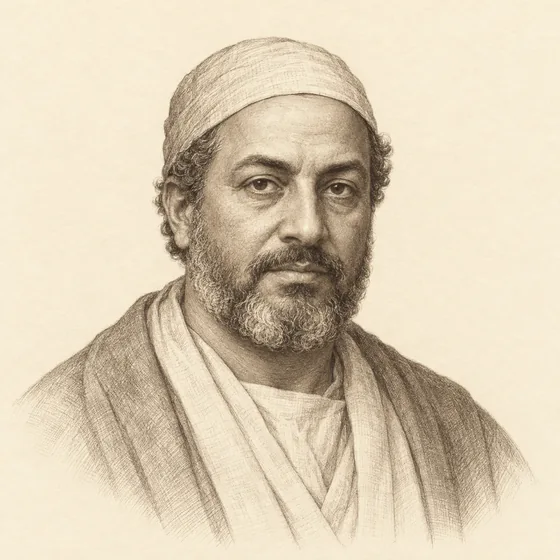
The person behind the ideas
Worked after al-Khwarizmi and before al-Karaji.
Combined algebra with geometric problems.
His writings later influenced Fibonacci.
More of the mathematics
Beyond whole-number coefficients
His algebra could use irrational quantities within equations, not just as answers.
Geometry and algebra
He applied algebra to regular pentagons and decagons and worked with powers above the square.