← Back to the timeline01 / ANTIQUITY TO THE RENAISSANCE
Ahmes (Ahmose)
c. 1650 BCE·Egypt
How do you share something equally? For Egyptian scribes, fractions made counting useful for food, land, and everyday work.
Explore the mathematics ↓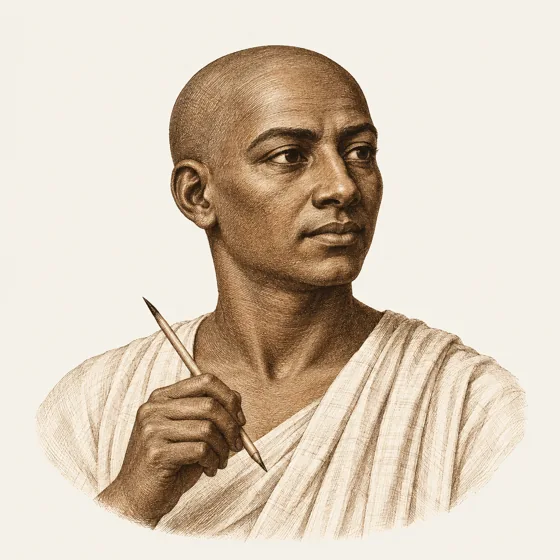 Imagined likeness
The person behind the ideas
- A scribe working in Egypt around 1650 BCE; the papyrus’s precise date is debated.
- Copied mathematical material from an older text, rather than claiming to invent it.
- Preserved worked problems about fractions, areas, and volumes.
01 / UNIT FRACTIONS
Share bread like an Egyptian scribe
The Rhind papyrus opens with problems like this one: share some loaves fairly among some people.
Egyptian scribes wrote each share with unit fractions: pieces with a 1 on top, like 1/2 or 1/6, each used once.
Share the bread fairly
Cut the loaves and hand out the pieces. Everyone must end up with exactly the same amount.
Problem:
Loaves
÷People
=Loaf per person
THE IDEADifferent cuts, the same amount: 2/3 of a loaf is exactly 1/2 + 1/6. A fraction is an amount, and there is more than one way to build it.
More of the mathematics
Practical geometry
The papyrus includes rules for areas and granary volumes: mathematics used to measure real things.
A written record
Its worked examples let us see how Egyptian scribes calculated thousands of years ago.