← Back to the timeline24 / ANTIQUITY TO THE RENAISSANCE
Abu Bakr al-Karaji
c. 953–1029 CE·Baghdad & Persia
Unpack a cube of blocks and lay its layers flat. Do this with cubes 1, 2, 3 and onwards, and the floor is always a perfect square.
Explore the mathematics ↓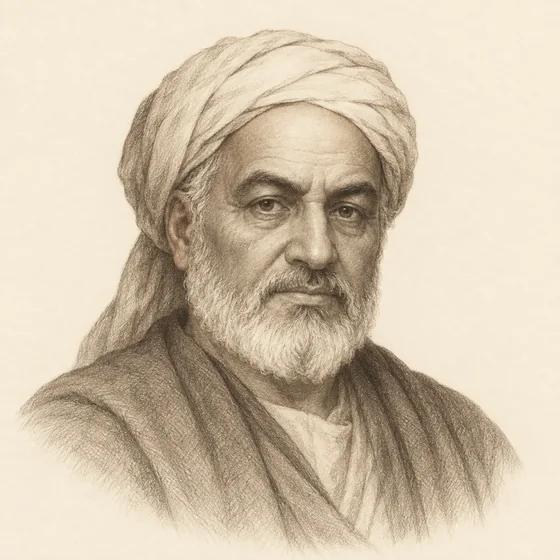 Imagined likeness
01 / SUMS OF CUBES
Why do cubes add up to a square?
Lay each cube’s blocks around the ones already on the floor. Each cube fills one L-shaped border.
Then count the layers in a border: one in the corner, the rest along the two arms.
Top view of the floor · each square is one block
THE IDEA1³ + 2³ + … + n³ = (1 + 2 + … + n)². Both sides count the same blocks, arranged differently.
The person behind the ideas
- Worked on algebra in Baghdad.
- Developed rules for manipulating powers and polynomial expressions.
- Used arguments that anticipate mathematical induction.
More of the mathematics
An argument that keeps going
The border for cube n has two arms of n × T blocks and an n × n corner. With T = n(n − 1)/2, that is n³ blocks.
Algebra beyond a picture
He developed operations on powers and sums of powers, helping algebra become less dependent on geometric constructions.