← Back to the timeline18 / ANTIQUITY TO THE RENAISSANCE
Muhammad ibn Musa al-Khwarizmi
c. 780–850 CE·Baghdad · present-day Iraq
A square garden and ten strips as long as its side cover 39 square units. Fill in four corners, and the garden’s side appears.
Explore the mathematics ↓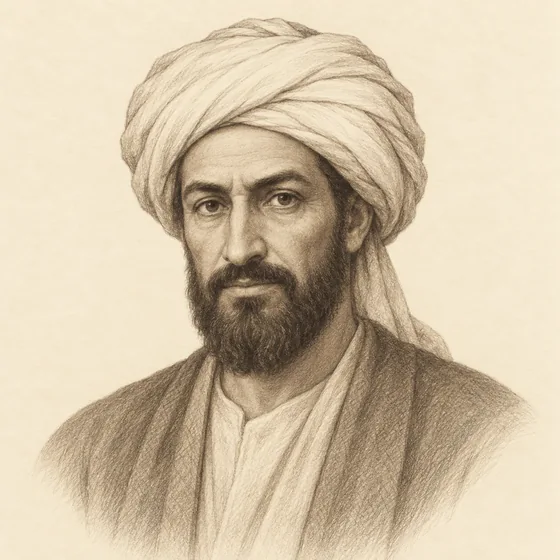 Imagined likeness
01 / COMPLETING THE SQUARE
Complete the square. Find the side.
A “root” is the side of the square. Share the 10 roots around the garden as four strips, then fill the four empty corners.
The completed square has a side you can find. The garden’s side is that length minus the two strips.
Problem:
THE IDEAAdding the missing corners turns x² + 10x into a whole square, (x + 5)². Its area is 39 + 25 = 64, its side 8, so x = 8 − 5 = 3.
The person behind the ideas
- Worked in Baghdad under Abbasid patronage.
- His algebra treatise treated linear and quadratic equations.
- His name is the source of the word “algorithm.”
More of the mathematics
Restoring and balancing
His methods systematically transformed equations into forms with known solutions.
Numerals and astronomy
He also wrote on Indian arithmetic, astronomical tables and geography.