← Back to the timeline15 / ANTIQUITY TO THE RENAISSANCE
Aryabhata
476–c. 550 CE·Kusumapura · India
Turn a water wheel and watch the bucket rise. Its height above the axle, compared with the radius, is what we now call the sine.
Explore the mathematics ↓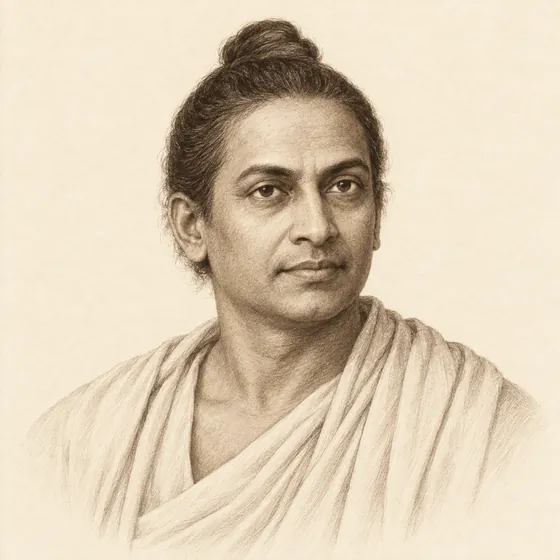 Imagined likeness
01 / FROM HALF-CHORD TO SINE
See sine in a turning wheel
Drag the bucket around the wheel. Its height above the axle is half of a chord: the bowstring of a bow-shaped arc.
Aryabhata listed that half-chord every 3¾° for a circle of radius 3438. Plot your own curve, then fill in his table.
How high does the bucket rise?
Drag the bucket around the water wheel. Its height above the axle is plotted on the chart as it moves.
Wheel radius:
THE IDEASine is a ratio: height above the axle ÷ radius. At 30°, the height is half the radius, so sin(30°) = 1/2.
The person behind the ideas
- Composed the Aryabhatiya in 499 CE.
- Included arithmetic, astronomical calculations and a table of sines.
- Explained the apparent daily motion of the sky through Earth’s rotation.
More of the mathematics
The pulverizer
His kuttaka procedure addressed equations requiring whole-number solutions.
A moving Earth
Aryabhata compared apparent motion with the way stationary objects seem to move backward from a moving boat.