Heron’s formula
With sides a, b, c and half-perimeter s = (a + b + c)/2, the area is √[s(s − a)(s − b)(s − c)].
09 / ANTIQUITY TO THE RENAISSANCE
A surveyor can walk around a field more easily than measure straight across it. Heron’s formula turns the three boundary lengths into an area.
Explore the mathematics ↓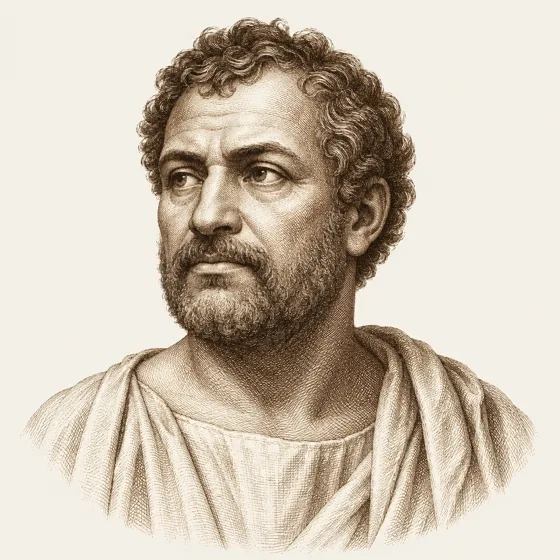
01 / TRIANGLE AREA
Walking the fences of a field is easy. Measuring straight across it, at a right angle to one side, is hard.
Heron gave a recipe for the area of a triangle using only its three side lengths.
This field has four fences: 6, 4, 6 and 4 metres. Drag its corner. The fences never change length.
Call the base c and the other fences a and b. A height h meets the base x from one end, so b² = x² + h² and a² = (c − x)² + h².
Subtracting gives x, then area² = c²h²/4. After careful algebra this becomes s(s − a)(s − b)(s − c), with s half the perimeter. Heron’s Metrica gives a geometric proof.
THE IDEAFour fences can wobble; three cannot. So three fence lengths fix a triangle’s area, and Heron’s recipe computes it: √(s(s − a)(s − b)(s − c)), where s is half the perimeter.
With sides a, b, c and half-perimeter s = (a + b + c)/2, the area is √[s(s − a)(s − b)(s − c)].
Heron wrote about surveying instruments, automata, and devices powered by air, water, and steam.