Cut a small cube from the corner of a big one. What is left is a smaller cube and three equal slabs, and that picture is the key to Tartaglia’s rule for the cubic.
Cut a corner from a big cube and count what is left.
Use the pieces to win Fior’s contest, then follow Tartaglia’s verse when the cubes are not whole.
Big cube:
Problem:
Equation:
Every small cube is 1 × 1 × 1 · one fixed scale · pieces are pulled apart, never resized
=
=
THE IDEAA u-cube without a v-cube corner is a cube of edge x = u − v and three slabs u × v × x, so x³ + 3uv·x = u³ − v³. To solve x³ + px = q, find two numbers with U − V = q and U × V = (p ÷ 3)³; then x = ∛U − ∛V.
The person behind the ideas
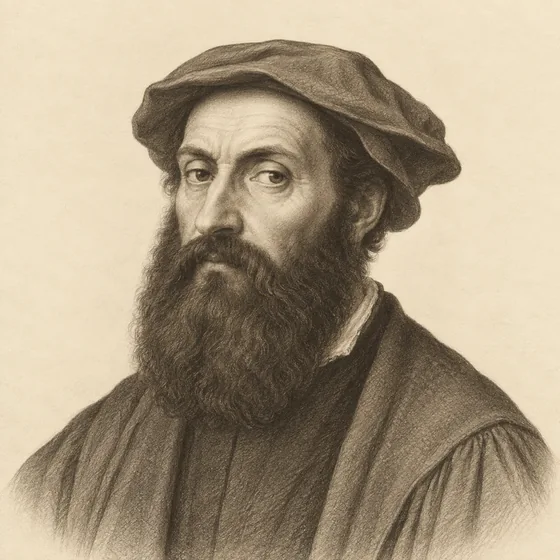
Won a public contest in 1535 by solving all thirty of Antonio Maria Fior’s cubic problems.
Gave his rule to Cardano in 1539, written as a verse.
Published the first Italian translation of Euclid’s Elements in 1543.
More of the mathematics
Two numbers from a difference and a product
Finding U and V from U − V and U × V is an old problem: square half the difference and add the product, and you get the square of half their sum.
When the rule breaks
For some cubics with three real roots, the rule needs the square root of a negative number. Working through that case led Rafael Bombelli to the first rules for complex numbers (1572).