Why the horns point away from the Sun
The bright edge of the Moon always faces the Sun, so the tips of a crescent point away from it. How high those tips stand, the “elevation of the cusps”, gives Nilakantha’s eighth chapter its title.
41 / ANTIQUITY TO THE RENAISSANCE
The Sun always lights half of the Moon. How much of that bright half we see depends on the angle between the Moon and the Sun, and Indian astronomers measured it with a versed sine.
Explore the mathematics ↓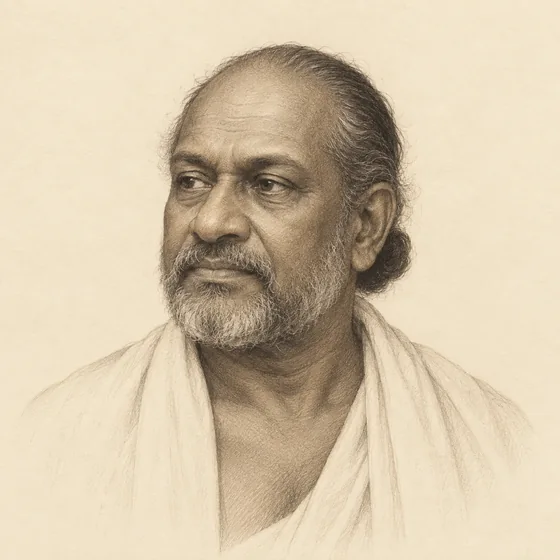
01 / THE MOON’S BRIGHT PART
Drag the Moon around the Earth and count how much of its face is bright.
Then see why the bright part is the versed sine of the angle between the Moon and the Sun, the quantity Indian astronomers used to compute it.
THE IDEAHalf the Moon is always sunlit. Seen from Earth, the bright part of its face is radius × (1 − cos θ), where θ is the angle between the Moon and the Sun: the versed sine of θ. At 60° a quarter of the face is bright; at 120°, three quarters.
The bright edge of the Moon always faces the Sun, so the tips of a crescent point away from it. How high those tips stand, the “elevation of the cusps”, gives Nilakantha’s eighth chapter its title.
Nilakantha’s treatise is an important source for the infinite series of Madhava’s school, which he extended. His astronomy revised earlier models of planetary motion.