A cube and a 2 × 2 beam share one length x. Together they must hold a target number of small cubes: x³ + 4x = B.
Khayyam drew a parabola and a circle built from the problem. Where they cross, both of their rules hold at once, and that point’s x solves the cubic.
Target volume:
Graph and blocks use one fixed scale: 1 unit = 1 small cube edge
=
=
THE IDEAFor x³ + 4x = B, the parabola gives x² = 2y and the circle on a diameter of B ÷ 4 gives y² = x(B ÷ 4 − x). At their crossing both hold, and together they give x³ + 4x = B.
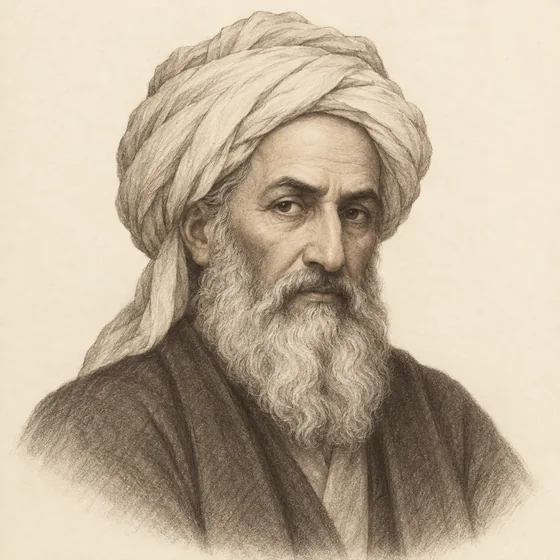
The person behind the ideas
Wrote an influential treatise on algebra.
Studied geometry and ratios as well as equations.
Worked on astronomy and calendar reform.
More of the mathematics
Different cubics, different curves
Khayyam used a suitable pair of conics for each type of cubic. This lesson explores just one type.
Why not the origin?
Both curves also pass through (0, 0), but x = 0 means no cube at all. Only the other crossing solves the problem.