← Back to the timeline12 / ANTIQUITY TO THE RENAISSANCE
Pappus of Alexandria
active c. 320 CE·Alexandria · Egypt
Put three pegs on each of two straight rails. Six strings, joined in a crossing pattern, hide a third straight line.
Explore the mathematics ↓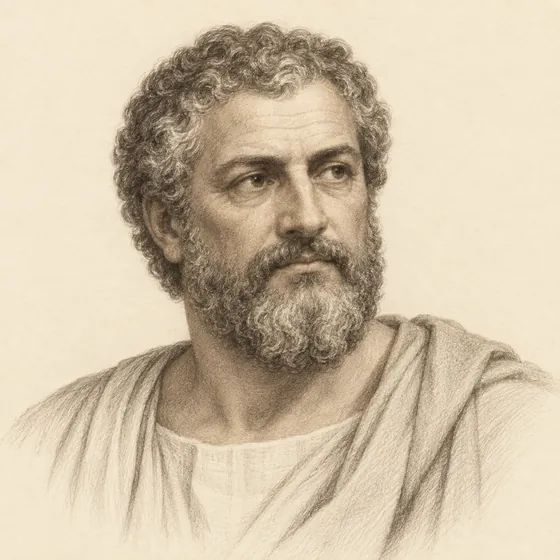 Imagined likeness
01 / PAPPUS’S THEOREM
Find the hidden straight line
Join the pegs in pairs, A to b and B to a, and mark where each pair of strings crosses.
Slide any peg or tilt a rail. The crossings move, yet they never leave one straight line.
Where do the first two strings cross?
Three pegs on each rail. String A to b and B to a, and mark where they cross.
THE IDEAThree points on one line and three on another produce three aligned crossings when connected in this pattern.
The person behind the ideas
- Worked in Alexandria in the fourth century CE.
- His Mathematical Collection preserved and extended earlier geometry.
- A theorem associated with his work later became important in projective geometry.
More of the mathematics
The Mathematical Collection
Pappus’s writings preserve material from works that would otherwise be lost.
Geometry of position
This theorem concerns points meeting and lining up, rather than a particular length or angle.