Number and music
The Pythagorean tradition connected musical intervals with simple numerical ratios.
03 / ANTIQUITY TO THE RENAISSANCE
A number squared is an area you can count. That picture is the starting point for understanding the theorem named after Pythagoras.
Explore the mathematics ↓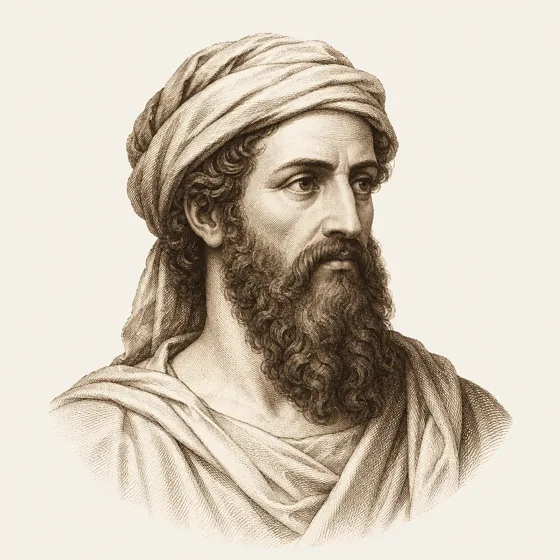
01 / SQUARE NUMBERS
A square floor 3 tiles wide and 3 tiles long needs 3 × 3 = 9 tiles.
That’s why 3 × 3 is written 3² and read “3 squared”. The little 2 means: multiply two copies of the number.
Drag the corner to make the floor bigger or smaller. Count the tiles.
THE IDEAA length counts units along an edge. An area counts unit squares covering a surface.
02 / THE PYTHAGOREAN THEOREM
Builders still check a corner with it: a triangle with sides 3, 4 and 5 always has a perfect right angle.
Build a square on each side of a right triangle. The two smaller squares always hold exactly as much as the biggest one.
Drag the two corners to change the triangle. Each square is tiled, so you can count its area.
THE IDEAFor any right triangle, a² + b² = c². Add the areas of the squares, not the lengths of the sides.
The Pythagorean tradition connected musical intervals with simple numerical ratios.
Arranging counters into squares or triangles makes number patterns visible.