A conditional construction
For n > 1, set p = 3·2ⁿ⁻¹ − 1, q = 3·2ⁿ − 1 and r = 9·2²ⁿ⁻¹ − 1. If all three are prime, 2ⁿpq and 2ⁿr are amicable.
20 / ANTIQUITY TO THE RENAISSANCE
Cut a rod 220 long into every size of equal piece that fits exactly. One piece of each size, end to end, measures 284, and 284’s pieces measure 220.
Explore the mathematics ↓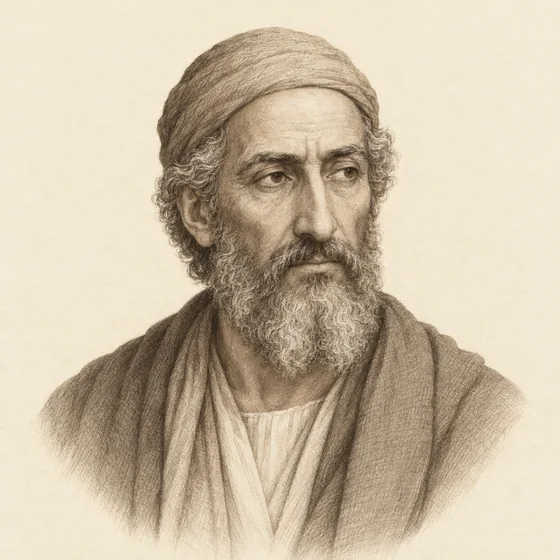
01 / AMICABLE NUMBERS
A divisor cuts a rod into equal pieces with nothing left over. Collect one piece of each size for 220, then for 284.
Then see why the pair works: Thabit’s rule builds two numbers whose divisors add up to the same total.
THE IDEAAmicable numbers are two numbers whose proper divisors each add up to the other: 220 → 284 → 220. Thabit proved a rule that makes such pairs when three numbers are prime.
For n > 1, set p = 3·2ⁿ⁻¹ − 1, q = 3·2ⁿ − 1 and r = 9·2²ⁿ⁻¹ − 1. If all three are prime, 2ⁿpq and 2ⁿr are amicable.
His work also addressed conic sections, ratios and geometrical problems.