A string runs from a hook in the wall, standing for the eye, to a corner of a chest. Where it passes through a glass frame is where that corner belongs in the drawing.
Use Dürer’s string machine to mark the corners of a chest on a glass.
Then move the chest to find out why far edges shrink, and why edges running away from you meet at one point.
Workshop drawn in a slanted view at one fixed scale · the glass is also shown face-on, at its own fixed scale
=
=
THE IDEAWith the glass 3 units from the eye, a point at distance Z is drawn at 3 ÷ Z of its offset: across = 3X ÷ Z, up = 3Y ÷ Z. Far edges shrink, and parallel edges running straight away from the eye all meet at the point straight ahead of it.
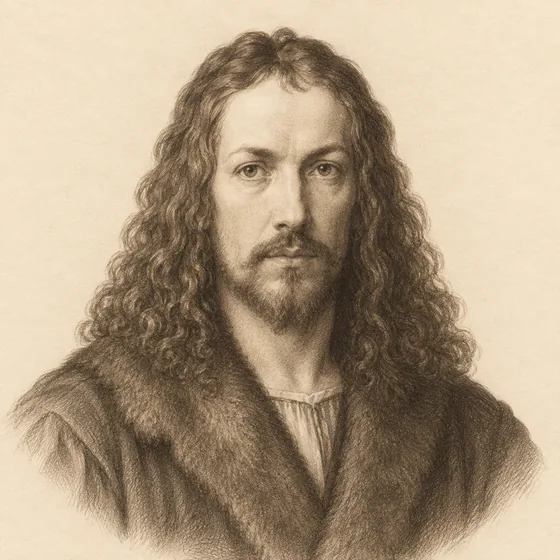
The person behind the ideas
Published Underweysung der Messung, a geometry book for artists, in 1525.
Visited Bologna to learn the mathematics of art, and read Euclid, Vitruvius, Alberti and Pacioli.
Published a book on fortification in 1527; his Treatise on Proportion appeared after his death in 1528.
More of the mathematics
Seeing through
Dürer explained the Latin word perspectiva as Durchsehung, “seeing through”: a picture is what you see through a window, fixed on the glass.
Geometry for makers
The same book teaches constructions of curves, polygons and letters, and its last part covers the Platonic and Archimedean solids, shadows and perspective.