A walker south of a round town can only just see a second walker past its wall. Those two walks fix the town’s width, and Li Ye turned that fact into an equation.
Resize the town until the sightline just grazes its wall.
Then name the unknown diameter and write every length in terms of it, as Li Ye did with his “celestial element”, 元.
B walks east:
Seen from above, north at the top · 1 pu (pace) drawn at one fixed scale · the close-up is fixed at ×8
=
=
THE IDEAA grazing sightline meets the radius at a right angle, so two triangles in the picture have the same shape. Naming the diameter d turns that into d³ + 16d² = 14,745,600, and the town is 240 pu across.
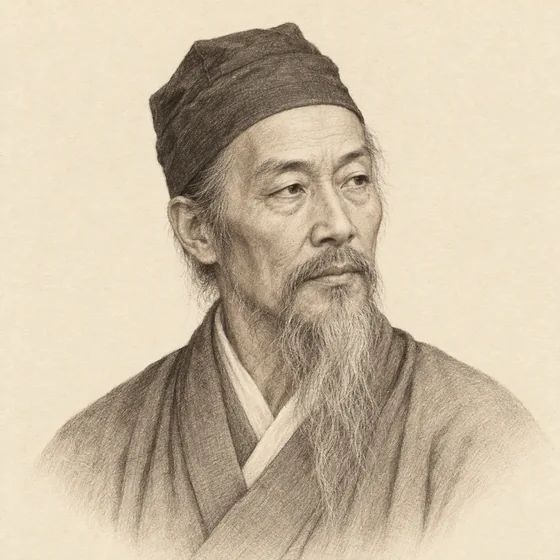
The person behind the ideas
Completed Sea Mirror of Circle Measurements in 1248.
Used the “celestial element” method to set up equations in one unknown.
Later wrote a more elementary mathematical text.
More of the mathematics
An equation as a column
Li Ye wrote only the coefficients, one row per power of the unknown, and marked the unknown’s row with 元. Negative numbers and decimal fractions were allowed.
One town, many problems
Sea Mirror has 170 problems built on one diagram of a round town inside a right triangle. In another of them both walkers leave the west gate: one goes 256 pu east, the other 480 pu south.